Milestones
- Learning and Training Phase – Pre-Requisites for the start of operation:
- Open Required Valves of Pump.
- Open Required Tank Valves.
- Set Up the BWTS for Ballasting.
- Start the System in Recirculation.
- Assessment Phase – Operational flow and Assessment:
- Select the Side for Ballasting.
- Run Both Sides of the System (Port and STBD).
- Attend to BWTS Alarms and Troubleshoot.
- Fill No.2 and No.4 Wing Tanks to the Desired Level.
- Return the System to Recirculation.
- Set Up for Stripping.
- Stop BWTS.
- Close the Tank Valves and Secure the System.
Actions During Exercise:
Deviation from Exercise:
After starting or resuming the ballasting, the user should not open any non-required valves or close any required valves. If this happens, a caution message will appear, instructing the user to undo the previous action. If the user fails to correct the action, the exercise will be terminated.
High trim & list difference:
After starting or resuming the ballasting operation, the user must maintain the list and trim angle below 1.5°. If the angle exceeds 1.5°, a low-priority message will be displayed, instructing the user to reduce the angle. If the angle is not corrected, the message will escalate to a high-priority alarm, and the exercise will be terminated within 5 minutes unless the angle is brought back below 1.5°.
Alarms & Remarks
| Alarm Condition |
Alarm Time |
Alarm Level |
Alarm Title |
Alarm Description |
Action |
|
|
remark |
Return The BWTS To Recirculation Mode |
Return to recirculation and start the stripping of ballast tanks. |
|
|
|
remark |
Neutralization Unit Pump NPU-100 Abnormal |
The Neutralization Unit Pump NPU 100 is abnormal. Reset the NPU 100 pump and return the system to sea to sea after acknowledging the alarm in BWTS panel. |
Acknowledge the alarm in BWTS Panel, return the system to recirculation and reset the NPU |
|
|
remark |
Neutralization Unit Pump NPU-101 Abnormal |
The Neutralization Unit Pump NPU 101 is abnormal. Reset the NPU 101 pump and return the system to sea to sea after acknowledging the alarm in BWTS panel. |
Acknowledge the alarm in BWTS Panel, return the system to recirculation and reset the NPU |
|
|
remark |
Valve BA008F Not Closing |
Reset and close valve BA008F after acknowledging the alarm in BWTS panel. |
Acknowledge the alarm in BWTS Panel, reset the valve and close the valve |
|
|
remark |
Valve BA004F Not Closing |
Reset and close valve BA004F after acknowledging the alarm in BWTS panel. |
Acknowledge the alarm in BWTS Panel, reset the valve and close the valve |
|
|
Low priority |
High Trim Difference between port and stbd |
High trim differences adjust tank filling valves accordingly. |
|
|
|
caution |
Deviation Detected |
Deviation from the exercise is detected, undo your last action. |
|
Step By Step Procedure
- Learning and Training Phase – Pre-Requisites for the start of operation:
- Open Required Valves of Pump
- Open the discharge, suction, and filling valves of ballast pumps 1 and 3.
- Navigate to the PMS page using the side navigation bar, or click the generator running box at the top of the ballast system page to start the second generator.
- Note: The tank filling valves (i.e., BWTS valves) will open automatically when the BWTS auto operation is initiated.
- Open Required Tank Valves
During the ballasting operation, we will be filling tanks 2(P), 2(S), 4(P), and 4(S).
Open the following tank filling valves:
-
- BA511F
- BA507F
- BA510F
- BA506F
- Set Up BWTS for De-ballasting
- Navigate to the BWTS page by clicking the BWTS rectangular box on the ballast system page or via the side navigation bar.
- Turn on the BWTS.
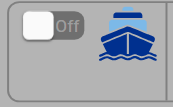
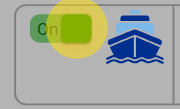
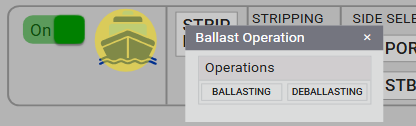
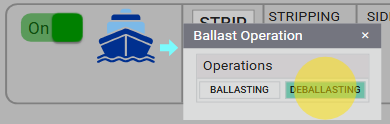
- Click the ship icon and select De-ballasting Operation.
- Start the System in Recirculation
-
- Select the Recirculation side in the BWTS Panel.
-
- Click Auto Start to initiate the BWTS system.
- Once the BWTS valves are open, the ballast pump can be started in recirculation mode.
- Assessment Phase – Operational flow and Assessment:
- Select the Side for Ballasting
After successfully running the system in recirculation:
-
- Select the desired side option (Port or Starboard) in the BWTS panel.
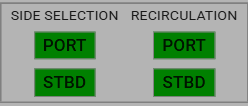
- Open the cross suction valves and close suction valves.
- Deselect Recirculation Mode to switch to Side Mode.
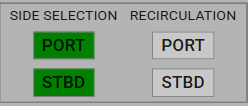
During the first 3 minutes, maintain a low of 950 – 1050 m³/h.
After 3 minutes, you will receive an alert to increase the pump flow rate.
- Run Both Sides of the System (Port and Starboard)
-
- Activate both the Port and Starboard sides of the system to ensure balanced operation. This milestone is complete when both sides are running.
- Attend to BWTS Alarms and Troubleshoot
-
- During the de-ballasting operation, various BWTS-related alarms may be triggered. It is essential to take appropriate corrective actions in response to these alarms.
-
-
Neutralization Unit Pump Abnormal
-
-
- Acknowledge the alarm on the BWTS panel, then switch the system to Sea-to-Sea mode and reset the NPU pump.
-
-
- Acknowledge the alarm on the BWTS panel, then reset and close valve.
.
- Return the System to Recirculation
-
- To switch to Recirculation Mode, select the Recirculation side in the BWTS panel.
-
- Open ballast pumps suction valves and close cross suction valves.
- After Opening and closing the valves, Deselect the side selection.
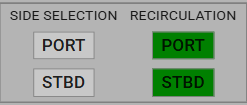
- Stop the ballast pumps after the system has been switched to Recirculation Mode
- Set Up for Stripping
-
- In the BWTS panel:
- Select Strip Mode.
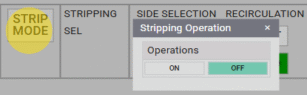
- Turn Stripping Operation to ON.
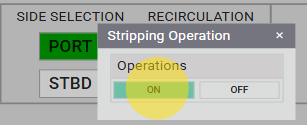
- Open the following valves:
- FD153F to 15%.
- BA201F.
- BA484F.
- BA156F.
- BA155F.
- Start the Bilge or Fire & GS Pump.
- Fill No.2 and No.4 Wing Tanks to the Desired Level
- Stop BWTS
-
- Once pumps are stopped, Turn off the ballast operation toggle switch in the BWTS Panel.
- Close The Tank Valves and Secure The System.
-
- After stopping the stripping pumps, close the tank filling valves that were opened during the process.
- BA511F.
- BA507F.
- BA510F.
- BA506F.
-
- Close all valves that were opened during the BWTS auto operation by clicking Auto Stop. Then, manually close any other valves that were opened to complete the process.